As you might know, I have been recording for about 14 years, never having very decent equipment to work with. My outlook has always been that it is better for me to have a drum set, bass, multiple guitars, mics, and a recorder, all told, spending the same amount that most musician-types would spend on one of their primary instruments. Over the years, I have amassed these things at a total cost when new of around $1200. Most everything I have is getting old these days, including my own self.
Ingenuity and a love of the writing and recording process has lead me to write and record over 200 songs, on most of which I played all the instruments, sang, recorded, mixed, and mastered all by myself.
Anyway, I have decided to generate this post as a peek into my process, for those that may be interested.
The terminology I use is specific to the tools that I use. The recorder is a Fostex MR8HD. WAV Manager is a free software available from Fostex for importing / exporting tracks between the recorder's 40GB hard drive and the PC. The multi-track software that I use is of alien technology that no one has ever heard of before and is not available to the public.
:)
This song and recording in particular are featured on my latest self-published album "Ten Years After", which can be downloaded for free (including album art to print your own self) from this site. Just go to Recordings, then Discography. There's a bunch of other crap here too. Songs, fiction, poetry, etc. Go poke around some later.
My process starts off with making a click track. I play guitar along with a click and sing a quick scratch track, simply to have something in my ears when recording drums. It doesn't have to sound good and usually sounds bad. I mix down a stereo track and import tracks tr07 and tr08 into the recorder. I record drums on tracks 1-4 while listening to tracks 7 & 8 in the headphones.
These are my drums:
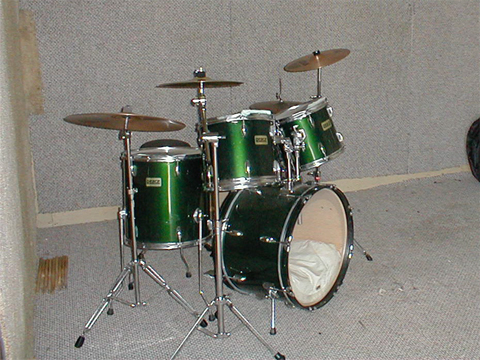
I bought them new on eBay a few years ago. "Peace" brand. They were $350 shipped, including hardware. I have about another $150 in cymbals now, the best of which are Sabian B8 Pro, which means they are not very good.
I recorded these drum tracks in a storage shed that is approximately 10ft x 30ft, with plank oak walls and floor, and a corrugated tin roof that is around 7ft high. Not the ideal acoustics for putting a good recording together, especially of drums. I placed a dynamic mic on the kick drum head, another in between the snare and hi-hat (above the snare, below the hi-hat), then two Nady CM90 condenser mics ($40 each from Musicians Friend) about 5ft up, one over the snare and one over the floor tom.
When the recording was complete, I came home, created a new folder on the computer, located in the C:\SESSIONS\ folder, called "Flood 20060101", Flood being the name of the song, 01/01/2006 being the date that I dumped the raw drum tracks out of the recorder onto the PC.
Inside C:\SESSIONS\Flood 20060101, I created a new folder called "raw drums" and dumped the drums from the recorder into this folder. The tracks, as you will see in the next video, are named TR01, TR02, TR03, TR04, which is the behavior of the Fostex recorder and software.
I created a new session in my alien technology multi-tracking software and dragged these four tracks in. A minimal amount of volume and panning tweaking is necessary at this point.
Here is the raw drum video:
I saved the multi-track session as "raw drums 20060101.ses".
I then saved a new copy of the session as "drums 20060101.ses", saved a new copy of each of the wav files into a new folder called "drums", and then was free to do whatever I wanted to, trial and error, to get a good mix, without risk of damaging or losing the original tracks or session. This is a theme that you will notice continues throughout my process with each song after each round of recording and mixing.
I first applied noise reduction, then a light compression, then a little EQ to brighten them up after the compression darkened them a bit. I then found a reverb that I liked, applied about 15% to the kick and overhead mics, and 60% to the snare. Listening to the drums by themselves, this is much more reverb than I am comfortable with, but it all gets lost in the mix with other instruments.
When this was done, I saved the changes to the session file and the wavs. I then played around with the mix for a few days, finding just the right sound (this particular track was nearing the end of a major, twenty-some song recording project, so there were other things going on) and then saved a stereo mix-down track called "stereo drum mix.wav".
Here is the effected drum video:
I loaded this into the recorder as the new tracks 7 and 8, put on my headphones and recorded guitar tracks. I had two mics on my hollow-body electric guitar (a Johnson ES-400-N, $350 new with hardshell case) seen below:
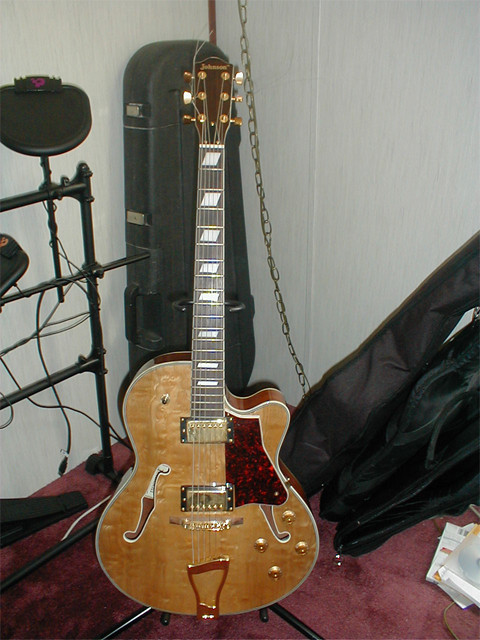
One mic (an Oktava large diaphragm vocal condenser) was pointing at the neck/body joint, which has a very thick, warm sound, and the other mic (Nady CM90, small diaphragm condenser) was pointing at the tail piece behind the bridge, for a much thinner, trebly sound. When the recording process was done, I dumped the guitar tracks (TR01 through TR04 again) down to the PC in a new folder called "guitars".
I created a new session, loaded in the stereo drums mix and added all four guitar tracks to the mix. I panned the two tracks (TR01 and TR02) of the first take hard left and hard right. I then panned the two tracks of the second take (TR03 and TR04) the opposite direction, for a very full, chorusy sound achieved without any effects. I didn't do any EQ or reverb on the guitars, just noise reduction and light compression.
Here is the guitars added video:
I saved a new session called "D&G 20060121.ses" (drums & guitar and the date). I then mixed down each take as a stereo mix named "stereo gtr mix 1.wav" and "stereo gtr mix 2.wav". Since I saved a new session for these mixes, I could always get back there and make minor adjustments, if needed, rather than having to start over if I realized, later, that I was drunk and not hearing the mix very well. It's easy to overdo it with EQ and stuff, so having a backup is a must.
I created a new stereo mix of all of the tracks (drums and guitar) and loaded it back onto the recorder on tracks 7 & 8, then recorded bass tracks.
My bass is total crap. A beginner's Epiphone SG copy, $99 from Musicians Friend, as seen below:
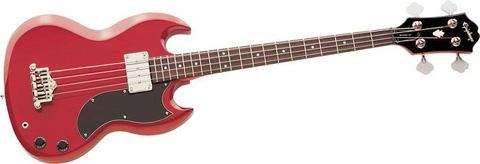
I played two takes of the bass line, because I wasn't sure about the first one. Then later, after listening to the bass in the mix, I decided to do an overdub, adding a second bass part into the bridge (or chorus B or whatever) of the song. Once I had added all the bass tracks into a new session with the drums and guitars ("DB&G 20060311.ses"), I decided to use all three takes in different capacities.
Here is the bass added video:
If you have been paying attention up to this point, you will see a pattern forming. I made a stereo mix of all the tracks in the session and uploaded it to the recorder as tracks 7 & 8, then started the vocals. If you haven't noticed, I do a lot of layering and overdubbing with the instruments in my recordings. Vocals are no exception. I love recording harmonies. Also, I double everything.
For whatever reason, I missed a step in the consistency department, maybe because over three months had passed by this point, but I added vocals to the same session as the bass work. Normally, after each round of recording, as seen in the previous steps, I always save the new round of tracks as one or two stereo mixes, then add the mixes into the next round of recordings. If I had not done this process up to this point, I would have 11 tracks open in the multi-track software instead of 6. If I had saved a single bass mix, there would only be 4 tracks open. This makes a huge difference in the performance of the computer, managing all these open tracks.
As I said earlier, keeping everything in separate sessions helps when you find something you don't like about the mix of the drums, or guitars, or something else that you have done previously. That particular session is saved separately, and hasn't been touched, allowing you to go back to exactly that point and change what needs to be changed, rather than trying to figure out what other tweaks you have done since the last round of mixes.
In the next example of [huh???], I saved the session with vocal mixes only, instead of saving it with bass mixes and individual vocal tracks (6 of them). So, again, adding to the previous example, if everything were properly in mixes at this point, I would have 7 files open, rather than the 9 that I have. Oh well...
Each vocal part is recorded twice, panned hard left and right. There are three distinct vocal parts in the song, therefore three distinct stereo mixes, made up of six tracks from the recorder. I recorded 1-4, then moved tracks 3 & 4 to tracks 5 & 6 and then recorded new tracks 3 & 4. I dumped all 6 vocal tracks down into the PC, in a "vocals" folder, then added them to a session called "DBG&V 20060319.ses". Apparently, it was in this same session that I saved the vocal tracks as mixes, then saved the session.
Here is the vocals added video:
The "Flood 20060101" folder, which contains all of these mixes, raw tracks, and sessions, nicely organized for backing up, is 811MB. That's a little more than a single data CD can hold. I have an external hard drive that everything gets copied over to, as well as DVD backups of most of this stuff. After all these years of recording, I only have a small percentage of them backed up and available as raw or even master session files. You can believe, though, that it is the most recent recordings, the last five years or so, that I have. Lessons learned...
Anyway, at this point, I have everything I need to complete the mix. A lot of times when I am to this point, after listening to the mix a bunch of times, I add shakers, tambourine, hand claps, vibraslap, or cowbell, whatever it might be lacking. As with most everything, I get two takes of each of them, sometimes playing off each other, then pan them accordingly left and right. All of these hard stereo panned doubling tracks make recordings especially fun to listen to in the car, in headphones, or a large room with the speakers far apart (AND LOUD!). Anywhere you can get a good appreciation for the sense of stereo panning is an extra little bonus. After listening on a boom box or computer speakers or something, you hear things that you never noticed before.
Here is the final mix video:
This file is large, so if you have a slow connection or whatever, just download the audio only:
Well, that's pretty much it. The final steps, in my experience, are to publish the recordings online, then watch them age without being listened to or appreciated as the 30-40 hour long process that goes into properly recording and mixing a 5 minute song.
There may be more of these posts coming down the pipe. It's hard to say. It was definitely a more interesting way of spending a few evenings, instead of my normal fare of video games and self loathing :)